Showing posts with label train. Show all posts

Friday, August 20, 2010

Limited express TSUBAME


The history of this Limited Express Tsubame started in 1930 when this limited express was driven between Tokyo Station and Kobe Station.


The time required of operation of Limited Express Tsubame at that time was 9 hours. It was no less than 2 hours shorter than the time required of the old limited express. JNR of those days tried all things for this operation.

Please look at a Japanese map. Mt. Fuji and Mt. Hakone which are volcanoes are on the west of Tokyo. The present main Tokaido line passes through them in a tunnel called the TANNA tunnel. The TANNA tunnel is 7804m in length and was a frightfully difficult construction. It was opened for traffic in 1934. This is a quake-prone area and during construction of the tunnel, big earthquakes caused the position of the tunnel to shift and cause accidents. The main Tokaido line till then avoided Mt. Hakone north, and passed through GOTENBA station. However, there was still a steep slope there. Therefore, an auxiliary steam locomotive was required. The Limited Express Tsubame connected the auxiliary engine in 30 seconds and it was separated during the run. Furthermore, the driver of the steam locomotive took the place of the fearful thing during the run. The limited express TSUBAME also connected the freight car carrying water. In this way, the limited express TSUBAME also saved time in supplying the water. However, the operation of the limited express TSUBAME was stopped by the Pacific War.

大きな地図で見る

Thursday, August 19, 2010

The Electric Multiple-Unit n age of Japan started.


Japan is a country with much mountainous land. Therefore, operation of railroads using electric power was desirable. However, there was a problem.
Much expense is required for electrification. The army was opposed to electrification of the railroad before the Pacific War. That is because they feared an attack on the power generation equipment. Electrification of the other local routes was only carried out on the section of a long tunnel through a mountain range.
However, electrification of the main Tokaido line progressed after the end of the war. It was the greatest main line in Japan. The Tokaido Shinkansen was still a dream at the time. The main Tokaido line, between Tokyo Station and KOUZU stations was electrified in 1925. However, the other section was not electrified. The economy of Japan collapsed in defeat of the Pacific War.
Therefore, the price of coal jumped up suddenly. Moreover, the railroad traffic increased rapidly after the revival of the war. The rest of the main Tokaido line was electrified in 1956. In this way, the Electric Multiple-Unit started a new age of Japan. As for the main Tokaido line till then, the limited express which has a glorious history was running. It was the Limited Express Tsubame. TSUBAME is a swallow in English. This mark was a symbol of JNR.
This train was a limited express which represents Japan from before the Pacific War. This train was used for trials on how to run the track in a narrow gauge of early Japan. It is a traditional tale.

Sunday, June 20, 2010

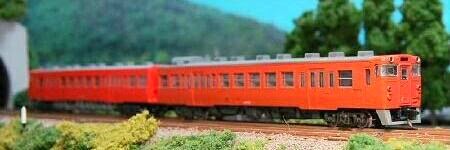
Japanese Diesel multiple unit "KIHA-40 Series"


I am writing today about the Japanese Diesel multiple unit which I introduced yesterday.
This Diesel multiple unit is "KIHA-47-8000, KIHA-140-2066,KIHA-147-1045".
The number of the Japanese train has a rule.
"KI"is Diesel multiple unit."HA"is Third Class Car till 1960.
Now,Japanese trains have two classes.
One is "Green car"(Second class car).This number is "RO".
The other is " Standard car".(Third Class Car)
What is the number of the first-class car which existed till 1960.
The first class car was "I".
"I,RO,HA"is one of the arrangements of a longtime Japanese word.
It is also a Japanese song;"I,Ro,HA,NI・・・"
It resembles the alphabet;"A,B,C,D・・・"
KIHA47, KIHA-140, and KIHA-147 belong to the same series.
That is the "KIHA"-40 Series.
Japan National Railways(JNR) made a total of 888 of these cars From 1977 to 1982.
JNR used it for the line in the whole country which was not electrified. However, JNR were privatized in 1987 and JNR became the present JR.
Each JR company has many "KIHA-40 Series" of this form even now.
Japan Railways group companies converted this "KIHA-40 Series"according to the special features of the area. Therefore," Hayato No Kaze" is the very characteristic body.
The "KIHA-40 Series" railroad model has many designs.
It is the same as that of actual cars.
This model is indispensable in order to reproduce the scenery of the districts in Japan. At the local station in Japan, these cars are often seen.